Adaptation Planning for the Water and Sanitation Sector

Two new publications provide insights and lessons from adaptation planning for the water and sanitation sector in two cities in Central America
The Inter-American Development Bank (IDB) and the Nordic Development Fund (NDF) have released two new publications with case studies of climate change impacts and adaptation options in the water and sanitation (WSA) sector. The two studies are key results of the Central America: Adaptation to Climate Change through Integrated Water Resources Management (IWRM) Practices in Honduras and Nicaragua project.
The main objective of the project was to provide input to policy development that further climate change adaptation in the water sector in Latin America. The project made two major case studies to analyse the potential impacts of climate change on the WSA sector in the cities of La Ceiba, Honduras, and Managua, Nicaragua. The two case studies provide insights into the interplay between current hazards, vulnerability, future projections, and adaptation options based on specific on-the-ground experience. The case studies served to inform the local governments about the need for advance planning to ensure that new investments and long-term plans take into consideration future climate projections.
The WSA sector is one of the most vulnerable to climate change, particularly in Central America. A region already significantly influenced by extreme hydrologic events, Central America is projected to experience more intense storms and flooding events. These events threaten to overwhelm already overtaxed water and sanitation systems. Advance planning is needed to ensure that new investments and long-term plans begin now to take into consideration climate projections. The WSA sector is characterised by large long-term infrastructure investments that can be difficult to modify once built, making it a particularly important sector to engage in long-term adaptation planning.
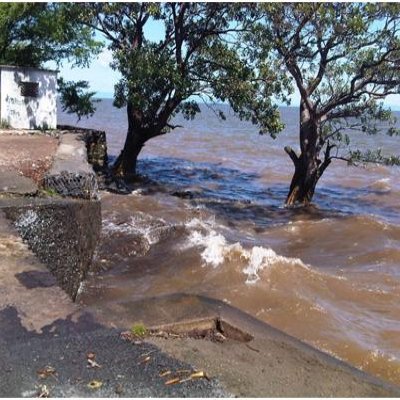
The cities of Managua and La Ceiba were chosen as case studies for several reasons. Firstly, they are both of high economic and political importance in their respective countries. Managua is the capital city of Nicaragua and La Ceiba is the third-largest city and tourist hub of Honduras. In addition, both cities face extensive challenges with urban flooding and are considered to be highly vulnerable to climate change. Finally, the types of flooding challenges faced by the two cities are quite different, providing a broad range of insights into urban adaptation planning for the region. Managua is a large, rapidly growing urban city with recurrent flooding from stormwater runoff. La Ceiba is a coastal city and faces threats from riverine flooding, sea level rise and storm surge, as well as stormwater runoff.
One of the major challenges for the WSA sector is its high reliance on infrastructure with a long lifespan. The relative permanence of such infrastructure makes it challenging to modify past decisions, and difficult to design for both current and future needs. In the face of uncertainty, decision-makers are faced with difficult choices. It is costly to over-design infrastructure, particularly for cities that are already struggling to build and maintain infrastructure for today’s conditions. At the same time, it is also costly or infeasible to replace or modify infrastructure as conditions change. Strategies including “no-regrets” adaptation measures that yield results even in the absence of climate change, reversible and flexible strategies that can be changed or retrofitted over time, thinking in terms of “safety margins” instead of projections to incorporate uncertainty, and relying more heavily on institutional and financial tools instead of infrastructure can be useful. The studies conclude that ultimately a combination of structural and non-structural measures that take into account climate change as well as the multiple other drivers of vulnerability will be needed to make urban water and sanitation systems resilient.
The two studies form part of a larger IDB initiative in the water and sanitation sector to develop on-the-ground knowledge that deepens the IDB's expertise on adaptation to climate change in the WSA sector and helps to define policies and better practices in adaptation at the regional and country levels.
More information
Climate Change Adaptation and Integrated Water Resource Management in Managua, Nicaragua
Climate Change Adaptation and Integrated Water Resource Management in La Ceiba, Honduras